In 2025, BookBup did a survey of authors and their use of AI[1]. Approximately 45% of the authors surveyed reported using generative AI to aid them professionally1] The most common use was research, the second was some aspect of marketing[2]. The reasons beyond those pertained to writing in plotting, outlining, editing and creating. The last of these, creating, is what we will look at today. In this post with FightWrite on the WD Blog, we will look at what to consider when you use AI to help you create your fight scene.
Before we go further, my personal opinion regarding the use of AI in writing is not expressed in this post. I am speaking from the standpoint of knowing that people use AI in all stages of their writing process. More specifically, they sometimes use it for their fight scenes. I know this because, while teaching a course on writing fight scenes, a student, within my hearing, proudly told another that he “just let AI write his fight scenes.” He then made eye contact with me. (Let that simmer a second.) Do not take this post as my seal of approval or disapproval of anything.
Now back to our regularly scheduled broadcast.
What Is Generative AI AI and your fight scene
Generative AI uses artificial intelligence to generate many types of content such as text, music, images and audio. It does so by means of user prompts. The user prompts are parameters or suggestions that you make in regards to what it creates. For example, I used the phrase “medieval battle cats with swords that looks like a realistic renaissance painting” to generate this epic image to advertise my book Fight Write, Round Two.
Behold:
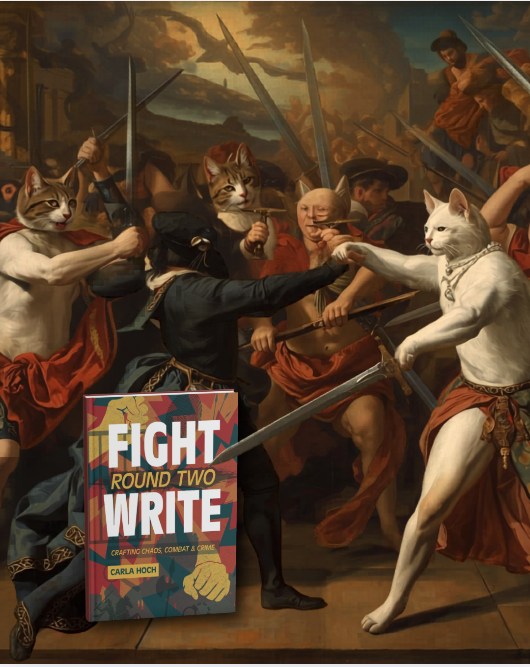
First, can we just all have a moment of awe for this creation. It is an epic, hot mess. Now, let’s also have a moment of ugh, because this picture is also an epically hot mess. Both the awe and ugh are very important.
How Generative AI Works – For Starfish
Starfish are amazing creatures. One of the most amazing things about them is that despite all of their seemingly intelligent capabilities, the do not have brains. My intention in this generative AI explanation is to break it down to its crudest definition so that even brainless starfish, and folks like me, can have a rudimentary understanding of it.
The Robot Library
Think of all the information on the internet as a library. Generative AI is like a robot librarian. You give it a task and it scans all the information in the library to complete that task. It has limitless possibilities. That is not to say that it is not limited.
Training the Robot Librarians
Like librarians, AI has to be trained to do its job. It receives its training by “reading” information in the internet library. For example, if you want to create an image of medieval battle cats with swords that looks like a realistic renaissance painting, the robot librarian will get information on each piece of that request. It will gather all types of media related to the medieval period, cats, swords and renaissance paintings.
The librarian will not gather every bit of information in the world on these subjects. For one, it doesn’t have access to every single piece of information on the internat. Some information is blocked. Think of that information like books the librarians can’t check out.
The robot librarian will stack up the books it has access to and look for patterns regarding the subjects in those books. These patterns are related to what visitors of the library are looking at and talking about most. So, the robot librarian might overlook a highly accurate book in favor of what is more popularly discussed on that same subject. For example, the librarian might give more attention to what is said in online forums about the subject rather than verified sources of information on that discussed subject. Kind of. Again, this is a starfish explanation.
Once the librarian identifies the patterns in the information, it makes conclusions based on those patterns. It then puts all those conclusions together and makes decisions based on those conclusions. For example, some conclusions AI made for my image are: the appearance of cat faces and bodies, swords common to the medieval period, how these swords were used, and common renaissance painting aesthetic.
Limits on the Librarians
The robot librarian had to pore over a lot of patterns of information to create the image I requested. And, it made a lot of valid decisions based on the conclusions it formed. Unfortunately, a valid reason isn’t always a sensible one. It’s a valid decision to illustrate swords being held in human hands. After all, sword handles are made for human hands. Unfortunately, putting human hands on a cat isn’t practical. Even if it were, that doesn’t explain why some cats in the picture have human hands while others have paws.
That said, it may be that the robot librarian found patterns that showed some cats have human hands and others don’t. Which leads to the next limitation of AI: it doesn’t know what is true. Robot librarians can’t separate truth from fiction. They also don’t know what information is created by other AI. The information patterns that the robot librarian is examining and then making conclusions from may not be based in fact at all.
Another issue for these librarians is they only know what goes on while they are clocked in at work. If the robot librarian stops learning at 1800 hours and new, factual content that greatly impacts information patterns comes out at 1801, the robot librarian will not know about it until it clocks back into work and starts learning again. Real time information is only known by AI if the AI is crawling information at that time.
Back to the Hot Mess
For all their limitations, robot librarians are very good at making changes to our work — which is one of their most helpful qualities. They don’t just create something and leave you to fix it. They will happily fix it. All you need to do is identify the changes that you want made. Let’s look back at my AI generated image. Here are some issues that I see right away and want changed.
Some of the cats have human hands. There’s also a pink, pig-faced, cat-human aberration in the middle of the picture that definitely needs to go. Also, the cats are wearing loin cloths. While that is in keeping with the renaissance aesthetic, it is creepy. Speaking of creepy, the white cat on the right has something hanging ‘twixt its hindlegs that I cannot give a name to. That must change. Plus, the angel in the top right has a mega-pec, some swords don’t have a blade, the white cat might be dancing with an executioner and that looks like the shadow of a pterodactyl in the background. (I might actually keep that one.)
You Have to Know What’s Right…
Some of the changes I am making are based on personal taste. But, for the most part, the biggest changes I want are based on what I know to be true. Even though what is happening in the image isn’t reality, I want it to be believable. To create the unrealistic, you have to start with what is real. I must know the real structure of cats. I must know the true appearance and use of swords. I must start with what you and I both know to be true before deviating into the reality I am creating. If everything in that image is completely untrue and incorrect, the story in it won’t be plausible.
…To See What’s Wrong
Let’s say that you are writing a book based on the Puss-In-Boots lore and this image is your fight scene. Look back at it again closely. But, instead of looking for the errors that are there, look for the errors in what is missing.
Ready? Go!
What’s not there? Well, for starters, there’s not a single scabbard. Those cats just carry those swords all the time. Also, there’s not dagger in sight. Where there is a sword, there is a dagger. Daggers are used for several things including close quarters combat as you see in this picture. Also, the white cat is fighting main gauche. Is that something you have mentioned about your character? Do you know what main gauche means? It refers to left-handed sword wielding. If your story is sword heavy, you need to know the problems of and posed by south paw swordsmen.
Also, the cruciform handle, such as is pictured, is not the best for a creature without fingers. Lack of fingers limits the use of the cruciform design. Also, that long sword is a bad idea for a cat. Puss-In-Boots uses a rapier, an espada ropera, in at least one case. A rapier is much lighter and quicker which is great for a cat as cats are light and fast. Puss-In-Boots also utilizes a hand guard which is perfect for paws. If he wields main gauche, that guard will have to be uniquely made for a left hand so you better write a great sword smith.
Oh, by the way, since your cats with swords story is based on Puss-In-Boots, you should know which version you are basing it on. Is it the Italian, German, or Dream Works Animation version? You have to know which version in order to guide your generative AI because not all of those cats wield a sword. The Italian Puss-In-Boots is solo stivali, niente spada. (Just boots, no sword.)
AI Is a Tool That YOU Must Wield.
In order for AI to aid you in writing your fight scene, you still have to know the basics of fighting. This is especially important with the more specialized knowledge that you include. If your character is punched once and that’s the extent of the fighting in your book, AI might provide sufficient guidance. Guidance being the key word. Don’t hand off the scene to AI completely.
If the back-and-forth action in your scene is extensive, AI might miss important details related to physics and injury which are the bread and butter of fighting. And, if your book follows a particular fighting style, AI might do more harm than good. That is not because the robot librarian won’t be able to construct a well written scene. It’s because, though well written, it might not be technically correct.
When To Use AI
If you use AI in your writing, consider using it as quality control. Let it examine the spelling, grammar, punctuation etc. Or, let it be a brain storming or outlining tool or help you with word choice when you are feeling stuck. Don’t rely on it to know the ins-and-outs of fighting. Remember, the robot librarian only has access to the patterns of information it sees in regards to fighting. It doesn’t necessarily know if those patterns of information are from verified sources. In fact, the information may be from video and/or roll playing games or content created by other AI.
If your work has fight scenes, acquaint yourself with fighting as much as you can. Visit and observe martial arts classes, videos created by professionals in the art/sport, watch sanctioned fights, post-fight break downs and fighter interviews. Above all, talk to fighters/professionals whenever possible. And, yes, buy my books or read my blog. You can also make an appointment with me through the contact form on my main page. The knowledge I give you will be true and verifiable because I’ve experienced it first hand or learned it from a real live instructor. If the knowledge you need is something I don’t have, I will make it my job to get it from verified sources and professionals. I can even make a video if you need.
AI is a tool. It’s the boxing glove. And while the glove is the point of contact for the strike, it doesn’t throw it. AI may be able to write a fight scene, but that doesn’t mean it will be able to land the knockout punch.
Until the next round with FightWrite, get blood on your pages.
[1] Robertson, Carlyn. “How Authors Are Thinking about AI (Survey of 1,200+ Authors).” BookBub Partners Blog, 15 May 2025, insights.bookbub.com/how-authors-are-thinking-about-ai-survey/.
[2] Jr, Thomas Umstattd. “Do 45% of Authors *Already* Use AI?! | Author Update.” Author Media, 23 May 2025, www.authormedia.com/do-45-of-authors-already-use-ai-author-update/.